
With the continued integration of digital finance and blockchain technology, institutions are placing greater emphasis on balancing decentralization with compliance, security, and long-term stability. Against this backdrop, LINK Capital launched C-LINK as a structured DeFi initiative centered on transparent, rule-based mechanisms.
Rather than positioning decentralization as a slogan, C-LINK is designed as a practical exploration of how on-chain rules and transparent execution can support sustainable Web3 infrastructure.
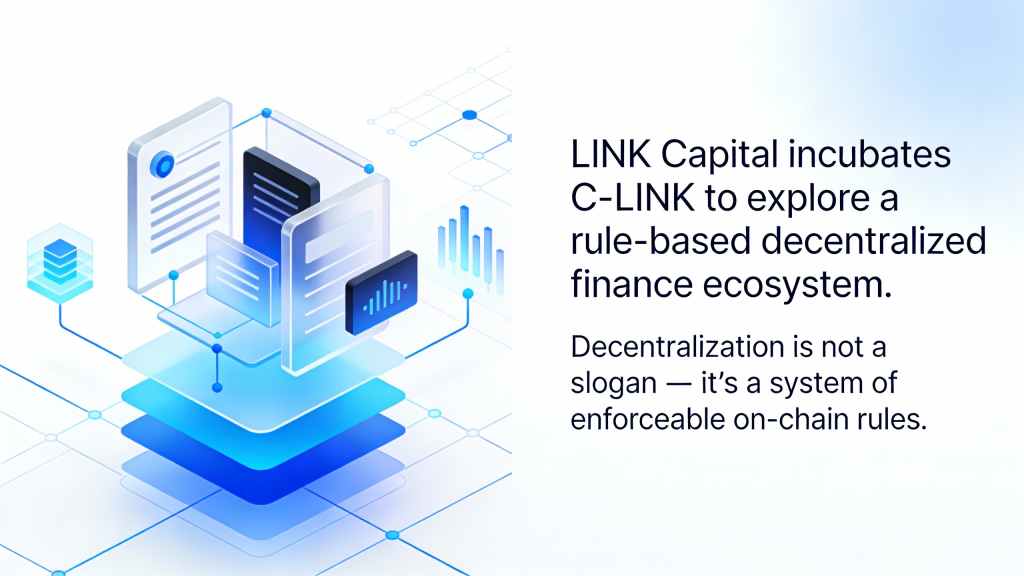
Background: From Financial Practice to Web3 Infrastructure
LINK Capital is a global fintech-oriented capital group with long-term involvement in blockchain technology, digital payments, smart contracts, and decentralized financial systems. Through years of industry engagement, the team observed that while Web3 innovation has accelerated, many decentralized projects continue to face structural challenges—such as opaque rule-setting, reliance on off-chain decision-making, and limited long-term stability.
These challenges highlighted a core issue: decentralization without clearly enforced rules often shifts trust from technology back to individuals or centralized entities. C-LINK was initiated in response to this gap, with the goal of exploring how decentralized systems can operate through clearly defined, verifiable, and enforceable on-chain logic.
Project Positioning: A Rule-Centric Ecosystem
C-LINK is not positioned as a single financial product. Instead, it functions as a decentralized ecosystem built around on-chain rule execution. Its core philosophy emphasizes minimizing discretionary control by embedding critical operational logic directly into smart contracts.
Within the C-LINK framework, core rules are deployed transparently on-chain and remain accessible for verification. Participants can independently observe system behavior through blockchain data, reducing reliance on centralized assurances and lowering trust barriers.
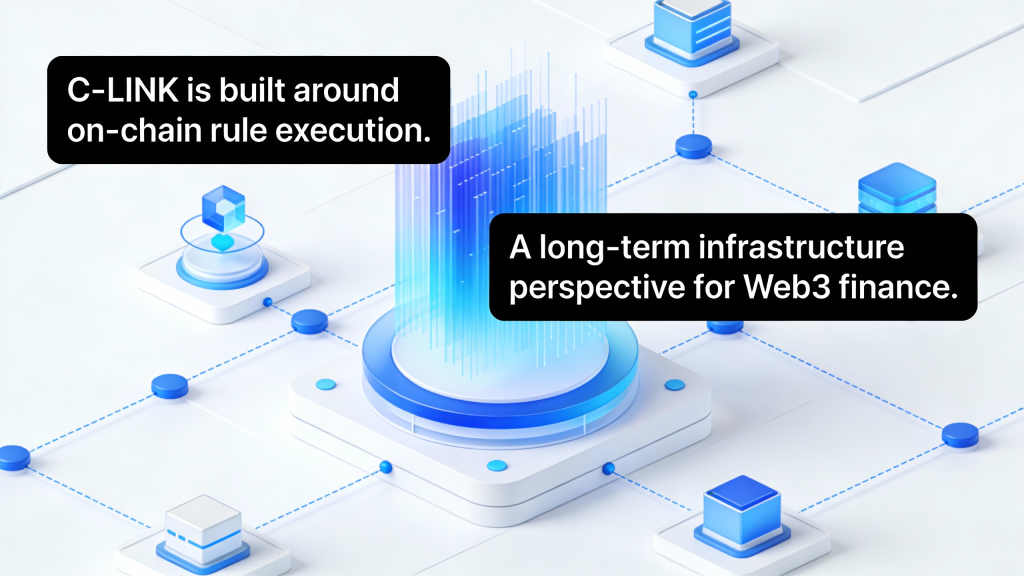
Structural Design and Transparency
From an architectural perspective, C-LINK relies on smart contracts as the foundation of ecosystem operation. Key processes are executed automatically according to predefined logic and recorded immutably on-chain. This approach ensures that system behavior is traceable and consistent over time.
By shifting operational trust from organizational authority to verifiable execution, C-LINK aims to enhance structural reliability while maintaining decentralized principles.
Participation and Ecosystem Operation
Participants within the C-LINK ecosystem engage under a unified set of on-chain rules. Interactions between different roles are coordinated through contract-based mechanisms rather than centralized intermediaries. This structure helps reduce information asymmetry and promotes transparent collaboration across the ecosystem.
C-LINK’s interpretation of decentralization does not exclude governance or system maintenance. Instead, it seeks to define clear boundaries through technology, ensuring that critical permissions and processes are governed by rules rather than discretionary intervention.
A Long-Term Infrastructure Perspective
From a broader planning perspective, C-LINK prioritizes structural stability and long-term sustainability. LINK Capital views the project as an exploratory model for balancing transparency, security, and operational efficiency within decentralized systems.
Rather than pursuing rapid expansion, C-LINK focuses on building a verifiable and durable framework that may serve as a reference point for future Web3 and digital finance ecosystems.